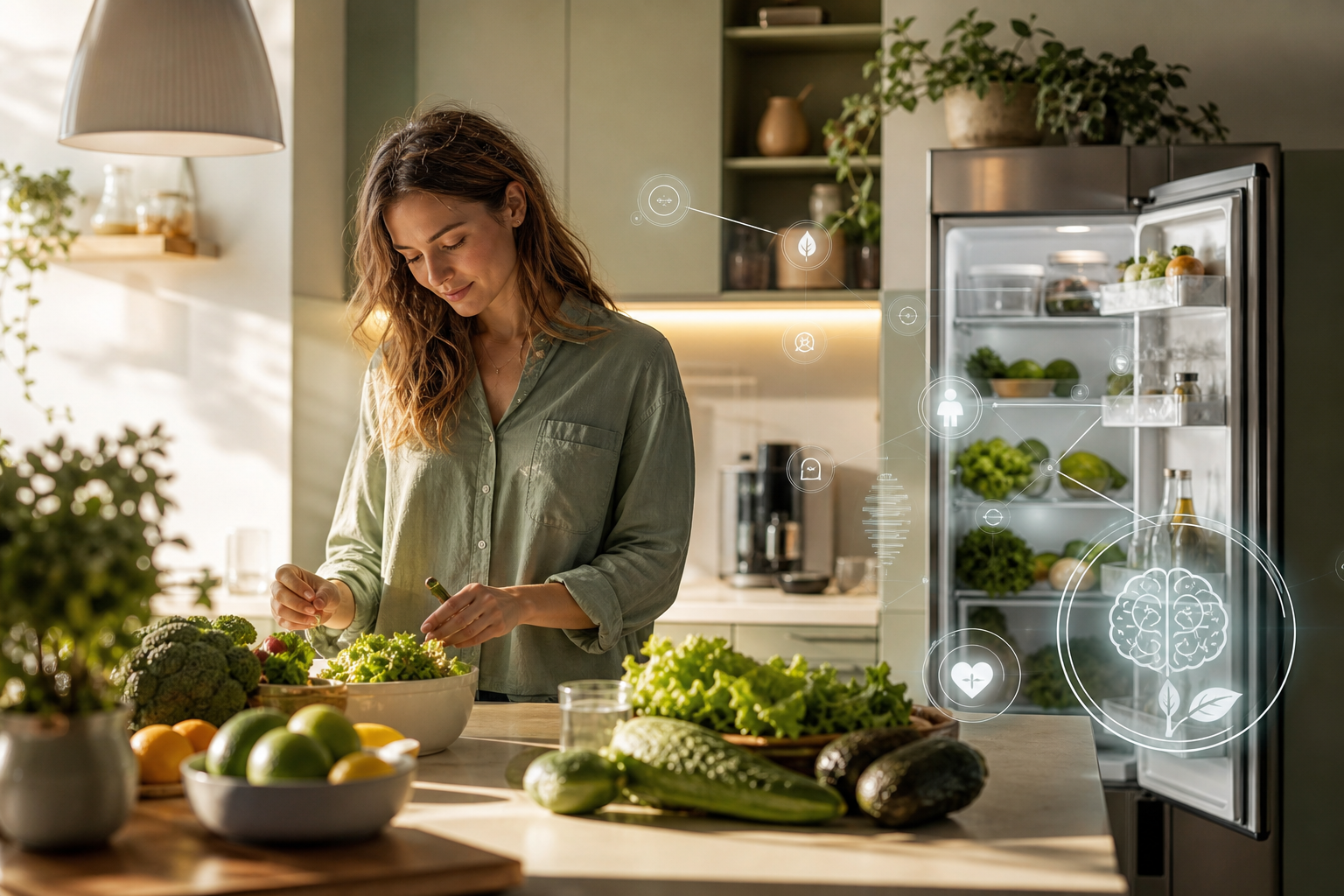
Most wellness advice tells you to track more — calories, macros, water, steps. But the real friction is not motivation. It is remembering what you actually bought, what is still in the fridge, and what you cooked last Tuesday when you were running on three hours of sleep.
That is where a smart AI home wellness system changes the game. Not another app you forget to open, but an embedded intelligence that lives inside the rhythms of your home — quietly observing what food comes in, what sits on the shelves, what gets eaten, and what recipes you reach for when life gets loud.
The invisible gap in women’s wellness
You already know nourishment matters. You have read about self-care micro-habits for busy women, experimented with cycle syncing for hormone balance, and maybe recovered from corporate burnout by protecting your evenings. Yet the kitchen — the centre of daily nourishment — often runs on autopilot.
Groceries arrive. Leftovers migrate to the back shelf. A delivery app fills the gap on Thursday. By Sunday, you cannot remember whether you ate enough iron-rich food during your luteal phase, or if stress snacking replaced actual meals three nights in a row.
Traditional food diaries fail because they ask you to manually log everything. Smart home AI flips that: it builds a living picture of your kitchen over weeks and months, using long-term memory to connect patterns you would never spot alone.
What your smart home actually tracks
A well-designed AI-powered smart home wellness layer does not need you to photograph every meal or scan barcodes religiously. Instead, it weaves signals from the spaces you already use:
1. Food coming into the house
When groceries cross your threshold — delivery boxes, market bags, meal-kit arrivals — your smart home can log what entered your food ecosystem. Over time, this reveals shopping rhythms: whether you stock fresh produce weekly, lean on ultra-processed convenience when overwhelmed, or cycle between ambitious batch-cooking phases and survival-mode toast.
This is not surveillance. It is context. Knowing your inbound food patterns helps the AI suggest gentler shopping lists aligned with your energy, cycle phase, or recovery goals — not generic “eat more greens” lectures.
2. What is in the fridge (and for how long)
Fridge intelligence is the unsung hero of kitchen wellness. An AI that remembers what is on each shelf, when it arrived, and what is approaching its use-by window reduces waste, saves money, and lowers the mental load of “what can I actually cook tonight?”
Imagine opening the fridge and your home softly surfaces: You have salmon, asparagus, and lemon — last time you combined these, you felt energised the next morning. That is long-term memory doing real work, not a gimmick.
3. What is being consumed
Consumption tracking through smart home sensors — smart plates, pantry weight sensors, appliance usage patterns, or voice-confirmed meal logging — builds an honest picture of what actually gets eaten, not what you planned to eat.
For women managing hormonal shifts, anxiety-driven appetite changes, or fatigue after long workdays, this data is compassionate. It shows that you skipped lunch twice this week without shaming you. It notices when evening snacking spikes during stressful sprints. It connects nourishment to how you felt — because the AI remembers both.
4. Recipes you cook (and when you cook them)
Your smart home learns which recipes you return to — the slow-cooker dal on Sunday, the fifteen-minute stir-fry on gym nights, the comfort pasta after hard meetings. It notes cooking frequency, prep time, seasonal preferences, and even which meals precede better sleep or steadier moods.
Over months, this becomes a personalised wellness cookbook written by your actual life — not a influencer’s aesthetic kitchen, but your real rhythms.
Long-term memory AI: why it matters
Short-term chatbots forget you by tomorrow. Long-term memory AI embedded in your smart home is different. It accumulates context across seasons:
- Your luteal-phase cravings versus follicular-phase energy
- How your eating shifts during deadline weeks
- Which foods correlate with better sleep, less bloating, or calmer mornings
- What your household actually eats versus what the meal plan assumed
This memory is what transforms raw kitchen data into actionable wellness insight — the kind that supports nervous-system care without adding another task to your plate.
The goal is not perfection. It is pattern literacy: understanding your body’s relationship with food in the environment where that relationship plays out every single day.
Wellness without the wellness overwhelm
A credible smart home wellness system should feel like the calm, evidence-informed guidance in the MyGirlHub Journal — not a drill sergeant in your kitchen.
Good AI nudges sound like:
- “You have ingredients for the soup that helped you sleep well last month — want the recipe?”
- “Produce from Monday’s shop is still fresh — here are two low-effort ideas.”
- “You’ve cooked at home four nights this week. Your burnout recovery goal was three.”
Bad AI sounds like calorie policing and red warning badges. Women deserve supportive infrastructure, especially when juggling work, caregiving, health fluctuations, and the mental load of feeding a household.
Pair smart kitchen insights with the grounding rituals in our self-care micro-habits guide and cycle-aware nutrition from cycle syncing for beginners — technology and embodiment working together.
Privacy, consent, and your data
Kitchen data is intimate. Any smart home food tracking worth trusting must offer:
- Local-first processing where possible — your eating patterns should not become advertising fuel
- Clear opt-in for each sensor or data source
- Easy deletion of memory windows you want forgotten
- Household-aware permissions — especially in shared homes
Wellness technology should earn trust the same way we expect from vetted practitioners in our directory: transparency first, hype never.
How this connects to the rest of your wellness stack
Smart home food intelligence does not replace medical advice, therapy, or blood work. It fills the daily gap between appointments — the Tuesday-through-Thursday stretch where intentions dissolve into whatever is fastest.
Combine it with:
- The Curated Wellness Edit — magnesium for sleep, planners for gentle habit tracking, and tools that support recovery without clutter
- Practitioner support — dietitians, GPs, and mental health professionals when patterns suggest you need human expertise
- Burnout recovery principles — because nourishment and nervous-system regulation are inseparable when you are depleted
Think of your smart home as the continuity layer — the memory-keeper that helps your future self make kinder choices when your present self is too tired to think.
The future is already in your kitchen
We are moving past the era of wellness as isolated apps and toward ambient, memory-rich environments that understand how you actually live. Your fridge, pantry, and stovetop generate more honest health data than any single wearable — because food is where biology meets culture, stress, joy, and survival.
An AI embedded in your smart home — one that remembers, learns, and gently reflects — turns that data into dignity. Not another chart to fail at. A partner that knows your kitchen as well as you do, and sometimes better on the hard weeks.
That is wellness infrastructure built for real women, real households, and real life.
Explore more in The MyGirlHub Journal — calm, credible guidance for your body, mind, and daily rhythms. For gentle product picks that complement a nourished home, visit The Curated Wellness Edit.